
EMI and RFI Filters: Selection Criteria and Application Guidance for Indian Equipment Manufacturers

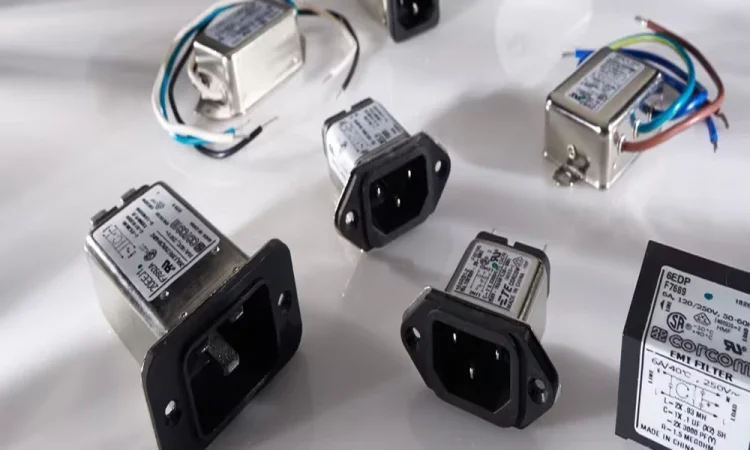

Electromagnetic interference management has moved from a niche concern of specialist engineers to a mainstream design requirement for the majority of electrical and electronic equipment manufactured in India. As export markets tighten their EMC compliance requirements and the Bureau of Indian Standards extends its mandatory certification coverage, EMI RFI filters have become essential components in the power entry design of an expanding range of product categories. Understanding what these filters do, how to select the right configuration, and what the sourcing landscape looks like in India is foundational knowledge for any equipment design or compliance team.
What EMI RFI Filters Do
EMI RFI filters are passive LC networks positioned at the power entry point of electrical equipment to attenuate conducted electromagnetic interference in both directions: preventing noise generated within the equipment from propagating onto the mains supply network, and preventing noise present on the mains supply from entering the equipment and disrupting its operation. Both directions of interference management are required by the EMC standards applicable to most equipment categories in both Indian and export markets.
The filter’s attenuation characteristics are expressed as insertion loss in decibels across a frequency range, typically from 150 kHz to 30 MHz for conducted emission applications. An EMI filter manufacturer India should be able to provide insertion loss curves measured under defined source and load impedance conditions, allowing design engineers to verify that the filter’s published attenuation matches the application’s specific requirements before specifying it into a product design.
Differential-Mode and Common-Mode Attenuation
All EMI RFI filters must address two distinct types of conducted interference simultaneously. Differential-mode interference appears between the line and neutral conductors of the supply. Common-mode interference appears simultaneously on both line and neutral conductors relative to earth. The filter’s internal circuit, combining X capacitors for differential-mode attenuation and Y capacitors and common-mode chokes for common-mode attenuation, addresses both interference types within a single housing. Design engineers should verify that the filter’s insertion loss specification covers both modes adequately for their specific application.
Filter Selection Parameters
Correct EMI filter selection requires clarity on the supply voltage and frequency, the maximum continuous current the filter must carry at rated load, the number of supply phases, the mounting configuration required by the enclosure design, and any specific regulatory certifications required for the target market. Mismatches between any of these parameters and the selected filter’s specification range result in either inadequate performance or premature component failure, both of which carry regulatory and reliability consequences.
EMI Filter Supplier India: What to Look For
When evaluating an EMI filter supplier India, the most important criteria beyond catalogue availability are the completeness and validity of product certifications, the availability of application engineering support, and the ability to supply consistently from stock without extended lead times that delay product development timelines. Certified filters with complete technical documentation simplify the equipment-level certification process by providing pre-validated evidence of the filter’s EMC performance that can be incorporated into the equipment’s technical construction file.
IEC Inlet Filters and Combination Units
IEC inlet filters, which combine the power entry connector and the EMI filter in a single compact housing, offer a space-efficient solution for equipment where the filter must be positioned immediately at the power entry point. These combination units eliminate the separate wiring run between the power entry connector and the filter that increases loop area and potential interference pickup in conventional separate-component designs, making them the preferred choice for compact equipment designs where minimising EMI is a priority alongside space efficiency.